A food dehydrator can help you turn fresh produce into ingredients and snacks for later use. The challenge in a small kitchen is finding an appliance that fits both your counter and your routine.
The smallest machine is not always the most practical choice. A compact dehydrator that handles too little food may require repeated batches, while a larger model with nesting trays might be easier to put away between uses.
The best compact food dehydrators deserve comparison on operating footprint, storage height, usable tray area, controls, and cleaning requirements. This guide covers five options for different needs, from occasional fruit drying to more regular small-batch use.
These are specification-based picks, rather than hands-on test results.
Amazon links open searches for the named models. Confirm the exact version, seller, included accessories, electrical requirements, and return terms. No affiliate tracking tag has been added.
Table of Contents
Quick Comparison: Five Food Dehydrators to Consider
| Product | Main reason to compare it | Included trays | Small-kitchen consideration |
|---|---|---|---|
| COSORI Premium Mini CFD-P501-SUS | Small cabinet-style design | 5 | Check door access and ventilation space |
| Hamilton Beach 32100 | Stackable design with digital controls | 5 | Allow room above it to remove trays |
| Elite Gourmet EFD319 | Simple round design for small batches | 5 | Measure the circular footprint |
| NESCO Snackmaster Jr. FD-41B | Compact cabinet with front access | 4 | Leave space to remove loaded trays |
| Presto Dehydro 06300 | Nesting trays for storage | 4, expandable to 8 | Storage-friendly; broader operating footprint |
Tray counts and features reflect the manufacturer versions discussed below.
1. COSORI Premium Mini 5-Tray Food Dehydrator
A cabinet-style option for a smaller counter
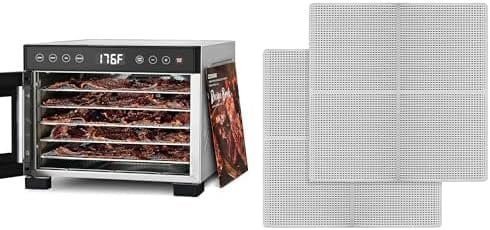 he COSORI Premium Mini, model CFD-P501-SUS, is worth comparing if you prefer slide-out trays to a stack of round trays. COSORI lists five trays, a 48-hour timer, and product dimensions of 13.9 × 11.3 × 8.9 inches. Its specifications identify a 480-watt, 120V/60Hz appliance.
That relatively low body height may help when choosing a countertop location. However, fitting the body into a gap does not establish that the location is suitable for operation. Check the manual’s required clearances and leave space to open the door and handle trays.
The tray format may appeal if you want to inspect or remove one batch without lifting several trays above it. Think about where a hot tray will go once removed; a small kitchen still needs a clear landing area.
Check the selected model’s manual for temperature limits, since the current product page contains differing temperature-range descriptions.
Why compare it: Front access, five trays, and a timer.
What to check: Operating clearances, exact temperature range, tray dimensions, and included liners.
2. Hamilton Beach Food Dehydrator 32100
A stackable option with useful included accessories
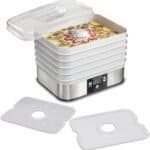 The Hamilton Beach 32100 combines five stackable trays with a 48-hour timer and automatic shutoff. Its digital thermostat adjusts from 100–160°F. Hamilton Beach lists dimensions of 13 inches wide × 10.5 inches deep × 11 inches high.
The package includes a fine-mesh sheet for smaller foods and a solid sheet for fruit rolls. Those accessories are useful comparison points because a machine’s base price may not include every surface needed for your recipes.
For a small kitchen, measure the space above the dehydrator as well as the counter beneath it. A stackable appliance needs room to lift the lid and trays.
Also consider cleanup. Confirm that the trays fit comfortably in your sink and follow the manufacturer’s washing instructions. A compact appliance becomes less convenient if cleaning it requires clearing the entire kitchen.
Why compare it: Digital controls and two useful accessory sheets.
What to check: Overhead access, tray-cleaning space, and whether the temperature range matches your planned recipes.
3. Elite Gourmet EFD319 5-Tier Food Dehydrator
 A simple round option for occasional small batches
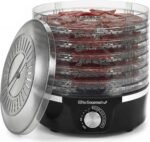
The Elite Gourmet EFD319 has five stackable trays, 350 watts of rated power, and adjustable temperature control. The manufacturer’s product illustrations show an approximately 11.4-inch width and 8.5-inch height.
Its small round body makes it a candidate for someone who wants to try dehydrating without dedicating space to a cabinet-style machine. Compare it for modest batches rather than assuming that five trays equal the capacity of every other five-tray model.
A circular footprint deserves a physical check on a narrow counter. Cut out a paper circle or mark the space with removable tape, then leave the additional clearance required by the manual.
The product page’s temperature descriptions differ slightly between its text and illustrations. Verify the range in the manual supplied with the exact unit. Also check timer functionality rather than assuming it is included.
Why compare it: A small body and straightforward adjustable controls.
What to check: Usable tray area, control features, and accessory availability.
4. NESCO Snackmaster Jr. FD-41B
 A small-batch cabinet with a viewing window
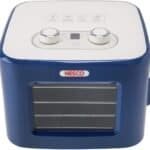
The NESCO Snackmaster Jr. FD-41B is designed for smaller batches. NESCO lists four mesh trays, an all-metal interior, a viewing window, and a metallic drip tray.
The controls provide a 95–175°F temperature range and a timer adjustable from 1–24 hours. Its front-access design is worth comparing if lifting a stack of trays would be inconvenient in your kitchen.
Four trays may sound limiting, but capacity should match what you actually prepare. Someone drying a few pieces of fruit has different needs from someone processing a large seasonal harvest.
Before ordering, check the external dimensions and leave a clear route for opening the door and pulling trays forward. Include space for the removed trays, not just the machine.
Consider your batch schedule, too. If your preferred recipes involve longer drying periods, understand how you would manage them within the available timer settings.
Why compare it: Front access, time and temperature controls, and a drip tray.
What to check: Whether four trays fit your typical batch and whether recipe times suit the timer range.
5. Presto Dehydro Electric Food Dehydrator 06300
A storage-focused alternative with nesting trays
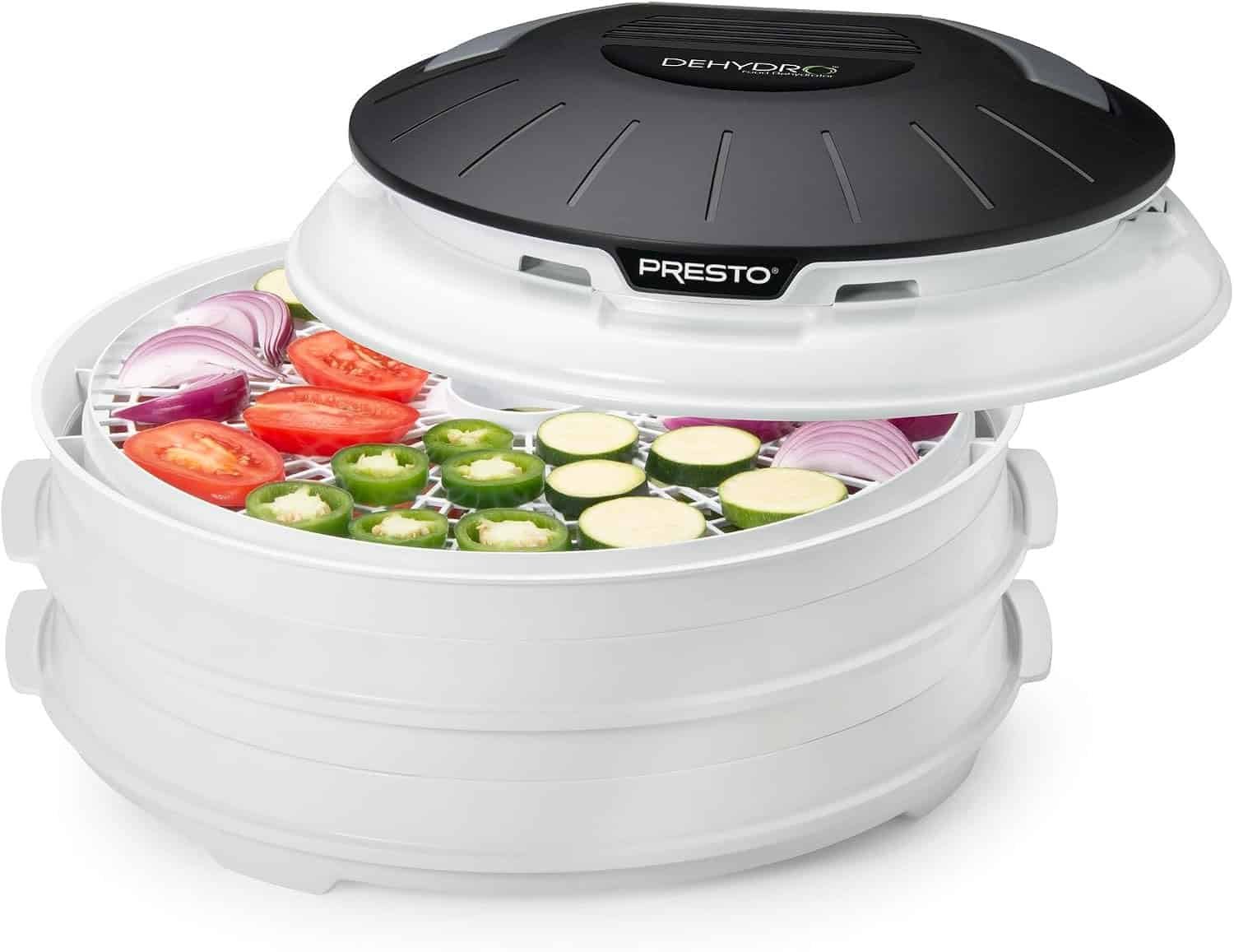 The Presto Dehydro 06300 includes four trays and can expand to eight using separately purchased trays. Its trays nest for storage, making it worth comparing when cupboard space is the main limitation.
The current manufacturer specification sheet lists an out-of-box size of 15.25 inches wide × 14.25 inches deep × 6.5 inches high. Presto also highlights a folding cover handle and cord storage around the cover.
This is a broader appliance than several other options here. Treat it as a compact-storage candidate rather than the obvious choice for the narrowest counter.
Check the exact version carefully. Use the manual and specification sheet corresponding to the appliance being sold, particularly when comparing older stock with current product photographs.
Why compare it: Nesting trays and optional additional capacity.
What to check: Operating height, control features, accessory costs, and product revision.
Amazon.com: Presto 06300 Dehydro Electric Food Dehydrator: Home & Kitchen
How to Choose a Compact Food Dehydrator
Measure Operating Space and Storage Space Separately
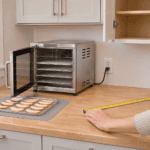 Record the available counter width, depth, and overhead space. Then check the cupboard or shelf where the appliance will live between batches.
A machine can fit inside a cabinet for storage without being suitable to run there. Follow its ventilation and placement instructions, and keep access to controls and the plug practical.
Include door swing, lid removal, and tray handling in your measurements. Also identify somewhere to place trays while loading and unloading them.
Compare Usable Tray Area
Tray count alone is not enough. Ask how many slices fit in the loading arrangement required by the recipe and manual.
Consider the trays’ shape, any central openings, and the space needed around food. If your usual batch would require several drying cycles, a slightly larger appliance may be more practical.
Start with the foods you actually expect to dry. Occasional herbs and sliced fruit call for a different purchasing decision from regular harvest processing.
Match Controls to Your Recipes
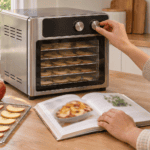 Look at the recipes you want to make before choosing a temperature range. Check temperature adjustment, timer limits, and what happens when the timer ends.
An automatic shutoff does not assess whether food has reached the correct dryness. Follow a reliable process and check the food rather than treating the display as a doneness test.
Avoid buying solely because an appliance offers the highest temperature or the longest timer. The useful features are those that match your intended recipes.
Check Cleaning and Accessories
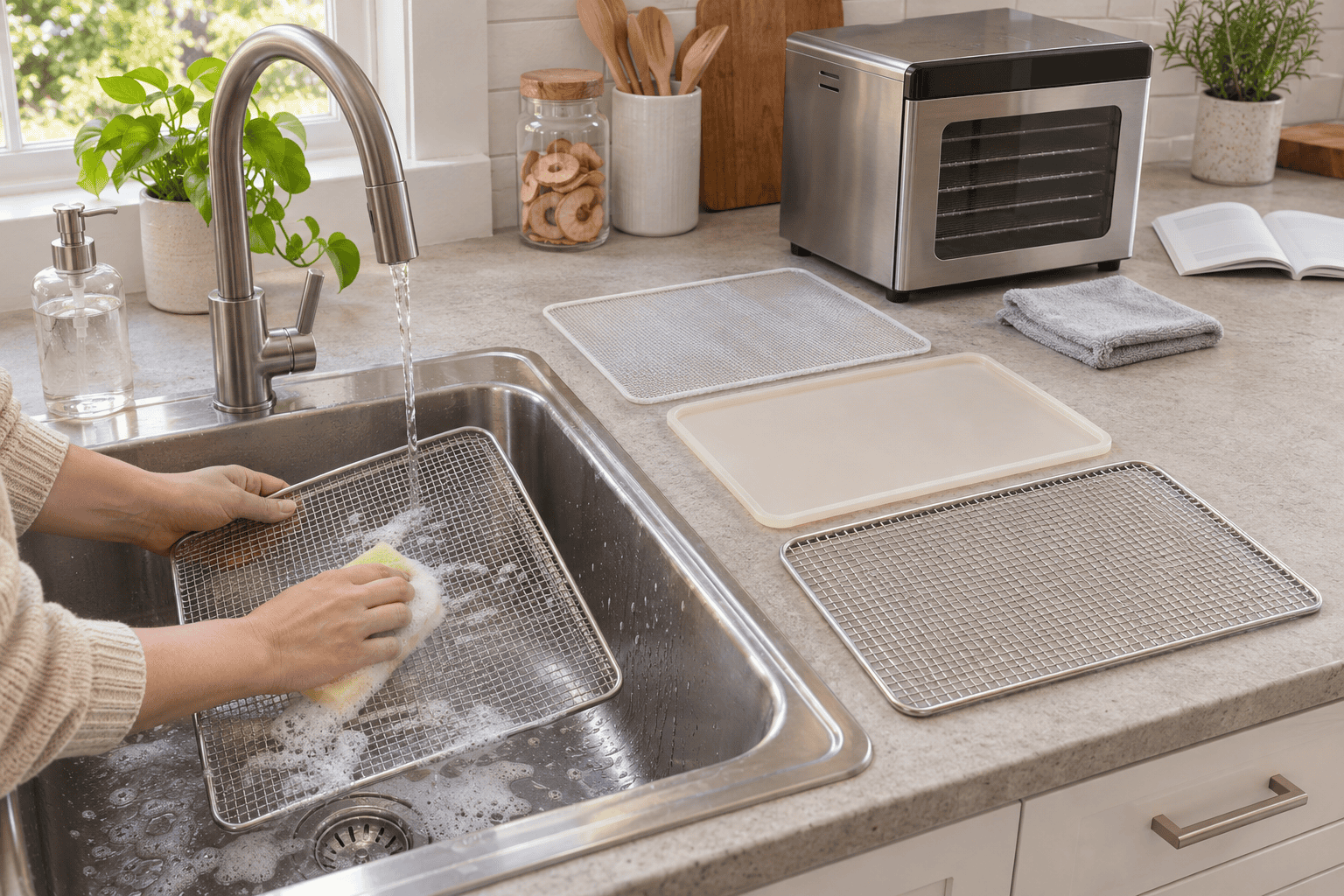 Find out which parts can be washed, which need wiping, and whether the trays fit your sink. Confirm dishwasher suitability in the exact manual.
For herbs, fruit leather, and sticky ingredients, check whether compatible mesh screens or solid sheets are included or sold separately.
Include those extras in the total purchase cost. An inexpensive machine may become less appealing once you add the accessories you need.
Confirm Electrical Compatibility
 The specifications discussed here include US-market models. Check the appliance’s voltage, frequency, and plug requirements against the country where it will be used.
A matching product name does not guarantee that an imported version has the right electrical specification.
Drying and Storing Food Safely
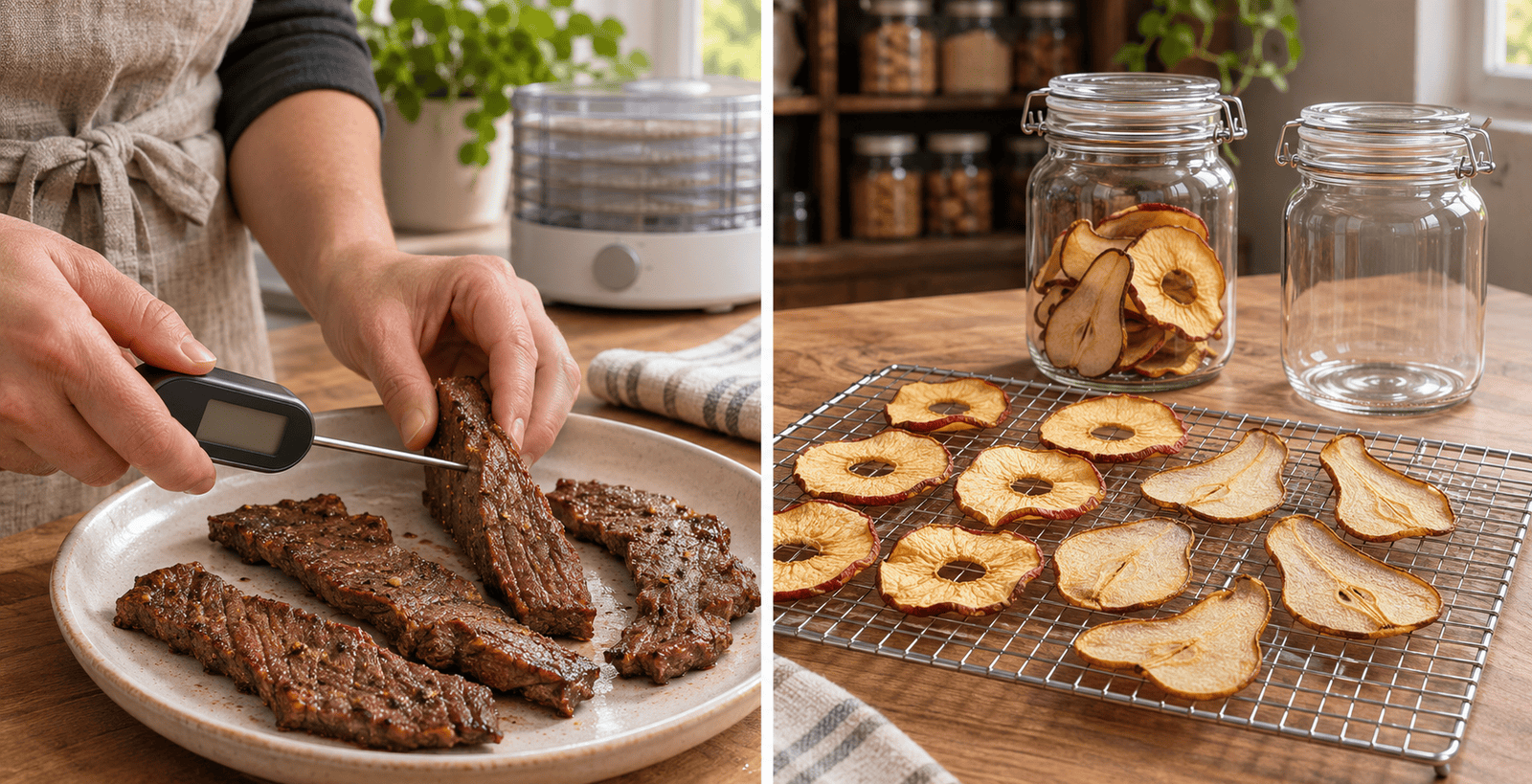 For meat or poultry jerky, USDA recommends heating meat to 160°F and poultry to 165°F before dehydration, checking with a food thermometer. A high dehydrator setting alone does not establish that the food has received this treatment.
Use a reliable food-specific drying procedure and the appliance instructions together.
For storage, the National Center for Home Food Preservation advises cooling dried food completely before packaging it in clean, dry containers that protect against insects and moisture. Store it in a cool, dry, dark place.
Its guidance calls for conditioning cooled dried fruit in loosely filled, sealed jars for 7–10 days, shaking daily and checking for condensation. If condensation appears, return the fruit for further drying. Discard moldy food.
Vacuum packaging can be useful, but it does not replace proper drying and handling.
Which Compact Dehydrator Should You Compare First?
Start with the limitation that matters most in your kitchen.
Compare COSORI for a small cabinet-style appliance, Hamilton Beach for stackable trays and included sheets, Elite Gourmet for a simple round design, NESCO for controlled small batches, and Presto for nesting storage.
Measure the operating space, check the exact model, and plan how you will clean and store both the appliance and finished food. A useful dehydrator should fit your routine as comfortably as it fits your kitchen.