[Updated February 2024]The kayak is one of the most versatile watercraft in existence and can be used for everything from fishing to exploring. But not all kayaks are created equal, and some models may be better suited to certain activities than others. Below you will find the list of the top five best kayaks for beginners to don’t have to spend hours researching.
Kayaking is a human invention that’s been around for thousands of years. Developed by the Inuit people to fish and transportation, it is now famous as a recreational sport. Like canoeing, kayaking offers a playful way to get out on the water and enjoy nature without exerting too much effort.
When someone tries recreational kayaking, they find that it offers a creative and fun way to exercise. Kayaking is a satisfying activity for those who want the physical benefits and need a bit of solitude.
For beginner paddlers, determining what kayak is best for them can seem complicated because there are different styles and models to choose from. An entry-level kayak will make the most sense as a starter boat if you’re keen on advancing your skills.
There are many different kayaks, which fall into five categories: sit-in kayaks, sit-on-top kayaks, inflatable boats, tandem kayaks, and folding.
The type can depend not only on what you are using it for but also on your body shape and size.
Choosing a kayak can be daunting. Here are the top 5 best choices for beginners, so you’re sure to find the best choice for you coming out of these reviews.
Table of Contents
Best Recreational: Intex Explorer K2 Inflatable Kayak Set
The Intex Explorer K2 Inflatable Kayak is a two-person kayak that easily folds into a compact size and weighs less than ten pounds. It makes it perfect for packing up and taking with you if you’re just looking for something easy to use on the go.
The kayak is crafted from durable vinyl and lightweight enough to carry around. The seat can be adjusted for one or two people and are surprisingly stable on the water.
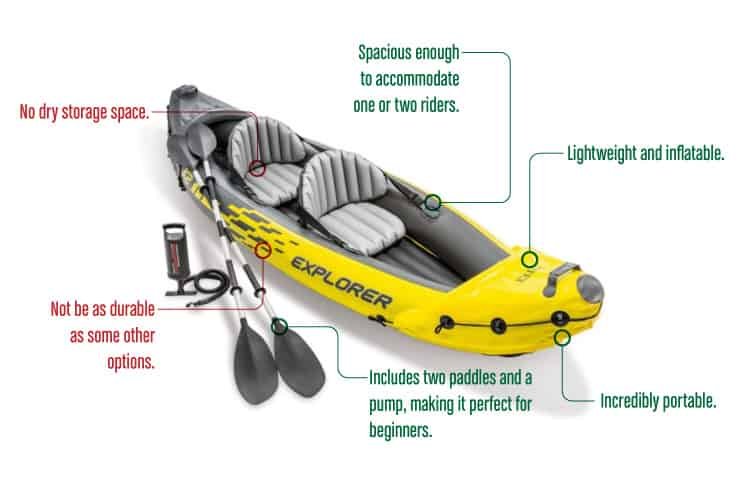 One of the best aspects of the kayak is its inflatable nature. This means that it takes up little space in your car or elsewhere for storage when not in use. It also supports 400lbs, ensuring you can bring just about anything you need on your journey with relative ease.
Weight: 35 pounds
Length: 10’2″
Pros
- Lightweight and inflatable
- Spacious enough to accommodate one or two riders
- Incredibly portable
- Includes two paddles and a pump, making it perfect for beginners
Cons
- It May not be as durable as some other options
- No dry storage space
Best Sit-On-Top Kayak: Wilderness Systems Tarpon 105
Our pick is the sit-on-top category is the Tarpon 105 by Wilderness Systems. As a recreational kayak, it offers impressive versatility and can perform well when used for various activities like fishing, camping, exploring, bird watching, and surf waves.
The Wilderness Systems Tarpon 105 is often recommended for beginners. This kayak has been updated with more features than previous models, making it a wise choice for those new to the sport.
Thanks to Wilderness Systems’ thoughtful design, any one of the Tarpon 105’s various features makes this kayak incredibly enjoyable for multiple conditions. Whether you enjoy flat water or a more flowing experience, the Tarpon 105 is made for you.
 The Tarpon 105 is excellent for fishing because it can hold a rod or fishfinder, navigates quickly in tight spaces, and is very stable.
At 10.5 feet long and 5 feet deep, the Tarpon 105 is shorter than many sit-on-top kayaks but more prominent in the “blade” area. As a result, this boat isn’t especially fast or incredibly efficient at gliding through the water smoothly.
For those seeking a boat for leisurely cruising, the Tarpon 105 might be your best option. For somewhat similar features and slightly more speed, consider purchasing the Tarpon 120.
The 105 best kayak for beginners has a flat hull that can turn quickly and smoothly. Paddling the boat requires minimal effort, resulting in quick direction changes.
The Tarpon 105 is an excellent kayak for long kayaking sessions, thanks to its comfortable Phase 3 AirPro seating system. The sharp contours of the backrest make this a compelling option for those committed to some severe paddling.
The Tarpon 105 impresses with several thoughtful features, including sizeable waterproof storage wells, magnetic water-bottle strap system, built-in paddle holder, rigid carry handles, and a dog-friendly deck.
The Tarpon 105 is a dynamic option for beginner paddlers who want stability and comfort in their kayak. It’s light enough to be carried with ease, and its shorter length makes it easier to maneuver as well.
The design of the Tarpon 105 is versatile and customizable, having comfort features without sacrificing durability, making it our choice for the top kayak.
Weight: 55 lbs.
Length: 10’6″
Pros:
- A comfortable seat for the beginner
- Small and light enough for anyone to get in and out of easily
- Considered to be one of the most agile kayaks on the market
- Useful for a variety of activities
- Packed with thoughtful design features
Cons:
- It glides slowly
- Expensive
Best Tandem Kayak: Advanced Elements Advanced Frame Convertible
This kayak is an inflatable kayak that can be paddled by either one or two people. The vessel is built for speed, comfort, durability, and practicality with features such as scupper plugs, a paddle leash attachment point for storage of the solo paddle while paddling tandem.
This kayak can be adjusted to accommodate a tandem or singles boat. The 550-pound capacity accommodates two children plus gear.
 This kayak has several easily accessible storage compartments that enable you to bring quite the array of gear with you. This design allows you to have all your essential belongings stashed in a central location, and it’s perfect for those seeking adventure on an extended excursion.
When paddling the Advanced Elements Convertible Tandem, you may forget that it is an inflatable kayak that handles like a rigid-sided boat. Equally impressive, this durable kayak offers three layers of material on the outside and inside to ensure it doesn’t tear easily.
The most important aspect of a kayak is the length, and at 15 feet, this kayak provides excellent tracking without losing too much stability with its relatively narrow 32-inch hull.
This kayak is spacious and comfortable for both paddlers in tandem mode. The seatbacks offer sufficient back support and are comfortable even after a full day on the water.
The low-lying seats on the kayaks allow your center of gravity to stay close to the water while paddling. This configuration reduces wind resistance and makes the boat feel more even.
When inflating and configuring the AE Convertible tandem kayak, beginners will need to work on their technique. The user manual includes a step-by-step guide for setting up the kayak, but one should practice how best to do so before heading out on the water.
Six air chambers are connected, but there are only a few of these that provide the structure of the kayak. It is easy for first-time kayakers to pump up to three out of these six balloons since they have strict pressure requirements.
Be careful when inflating because it can be accessible to over or under-inflate. These kayaks do not come with paddles or a pump, so choose wisely.
Overall, this is a heavy inflatable tandem that, in many ways, feels more like a solid plastic boat than an inflatable one. Its durability may be an upside for some users — it’s difficult to puncture and carries with minimal effort on your own.
It offers tracking and speed that many other inflatable kayaks simply cannot meet. It’s not cheap, but because of its durability, it is worth the investment especially if you want a boat to last.
Weight: 52 lbs.
Length: 15
Pros:
- Durable
- Capacity of 550 pounds.
- A kayak can be used as a single boat or a tandem
- Tracks well
- Handles speed with ease
- Roomy storage space
Cons:
- Heavy
- Expensive
- Setup can be tedious when there is only one person available to help
Best Budget: Intex Challenger K1
This inflatable kayak is our pick for the best inexpensive model on the market. Compared to other models, this boat was a bargain and will provide many hours of fun time in the water.
As a cheap kayak, the Challenger K1 does brilliantly on the water. The boat stays low in the water, making it steady and less effected by wind changes.
The K1 has a long, thin skeg that helps it move smoothly through the water. It’s 9 feet long and 2.5 feet wide, with a relatively short profile that lets you turn and steer easily.
One downside of the K1 is that there are no scupper holes. To drain water, you will have to pull the kayak ashore and turn it upside down so the water can run out.
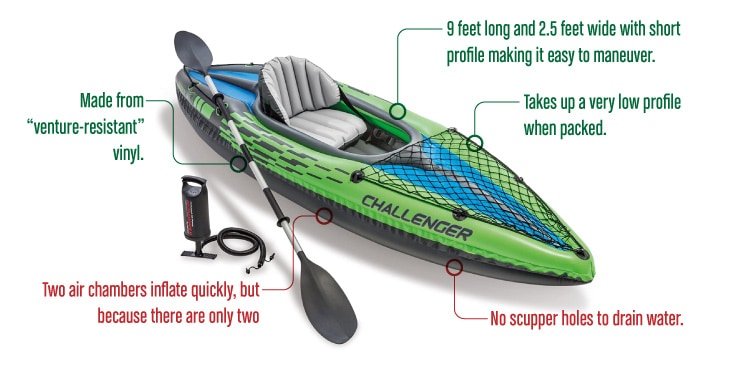 We like the inflatable seat, as it’s both removable and adjustable. The rubberized clamps make climbing in quick and easy. On the upper deck, a cargo net provides storage for stray items like water bottles or fishing gear. Though not spacious enough for camping gear, this boat can easily handle a variety of small items.
The K1 is made from “venture-resistant” vinyl. However, users should take care to keep it away from sharp objects since that could harm the boat while in use and when not in use.
Two air chambers inflate quickly, but because there are only two, it is important to wear a personal flotation device when using this kayak. If one of the chambers pops and becomes unusable, the remaining chamber will not provide much buoyancy in an emergency.
The K1 is one of the most affordable boats on the market, which makes it a great starter kayak for beginners. It comes with an 84-inch aluminum oar, a repair patch, and inflation pump. To set up the boat, simply inflate both chambers until the included gauge tells you that it’s ready to go.
When you are finished paddling for the day, dry off your boat and fold it up before returning to its carrying bag. When folded closed, the boat is small enough to be stored in most closets or even garages.
For a day of summer fun, the Intex K1 Challenger is great and makes for a wonderful and affordable addition to your kit. This kayak won’t best suit paddlers with racing or expeditionary aspirations, but it is perfect for beginners who are more concerned about affordability than anything else.
Weight: 23.9 lbs.
Length: 9
Pros:
- Affordable
- Packed up, this kayak is barely larger than a duffel bag
- Comes with a paddle and pump for inflation
- Tracks well and is easy to steer
- Adjustable seat
Cons:
- No drain plug
- This kayak is not the most durable
- The pump is too slow to inflate the kayak
Best Folding Kayak: Oru Inlet
For those who live in a tight space, folding kayaks offer the benefits of owning your own watercraft without needing a lot of storage space. The Oru Inlet folding kayak is perfect for anyone living in an apartment or van.
The Inlet, coming in at just 20 lbs without the paddle, is perfect for exploring creeks and back waterways. A simple snap and slip process can easily get you out on the water in under three minutes.
For easy carrying, this kayak easily folds up in seconds for storing in the trunk of your car or loading on a bus.
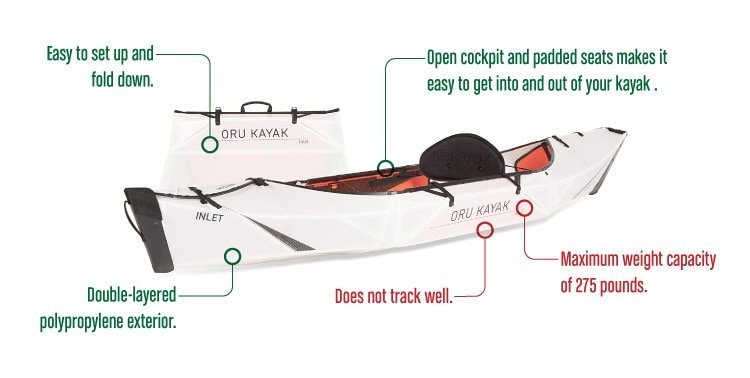 One stand out feature for beginners is Inlet’s durability. The kicks have a double-layered polypropylene exterior, but manufacturer testing has shown they can last up to 20,000 fold cycles before any problems arise. This stability is beneficial for fishing in rougher water as well as paddling on calmer days too.
Although the Inlet is not cheap, it offers great quality for the cost. If you are looking for space, storage, and money in your budget then this kayak should be a top contender.
This kayak has enough room for a small dry bag or a few pieces of fishing gear. However, you probably won’t have enough space for anything other than overnight accessories and there is no waterproof cargo area.
The Inlet by Oru is a niche kayak, but it earns its spot on this list of best beginner kayaks. With the user-friendly design and simplicity featured throughout every aspect of the experience, it’s easy to see why the Inlet excels in popularity among first time users.
It’s simple to set up, simple to paddle, and limited gear storage space is no longer an excuse for you not to go out kayaking. With the Oru Inlet, a quick setup and easy one-paddle paddle system means that you won’t be left without your watercraft.
Weight: 20 lbs.
Length: 10′
Pros:
- Super light craft
- This kayak is easy to set up and fold down, making it perfect for beginners
- When folded down, the kayak can be carried by a simple shoulder strap
- Padded seat
- Open cockpit makes it easy to get into and out of your kayak
- Beginner-friendly
Cons:
- Maximum weight capacity of 275 pounds
- Expensive
- This kayak does not track well
How to Choose the Kayaks for You
For beginners looking for a new kayak, our buying guide offers insider tips on how to choose the best one.
If you’re a beginner at kayaking, the first thing that matters is what kind of kayaking you want to do. Lots of good brands exist in the market for your consideration.
With so many kayak models on the market today, it is often difficult to choose one. However, knowing what you are looking for will help narrow down your search considerably.
If you want a kayak for recreation on nice clear water, then you don’t need one that is designed for surfing big waves. Similarly, if you are looking to transport your boat easily (maybe because of mobility issues), then large and heavy Kayaks will not be the best option.
To find the best kayak for you, there are a few factors to consider in each category.
In this buyer’s guide, we will provide information about many of these categories, including:- sit-on kayaks, sit-in kayaks, tandem kayaks and recreational day touring kayaks.
The first thing you will need to decide when it comes to buying a kayak is how and where you plan on using your boat. Once you’ve figured that out, other considerations include material, weight, capacity, durability, and price. Use this guide to help identify the best one for your needs even if you have no experience using them.
Types of Kayaks
Sit-On-Top Kayaks
Sit-on-top kayaks do not have a cockpit, or hollowed out seat that you must climb into. These boats simply allow you to sit on top of them and your legs won’t be below water.
Sit-on-top kayaks are easier to get in and out of than sit-in kayaks because they don’t require stepping into the boat. These wide vessels also feel more stable, especially for novice paddlers.
Sit-on-top kayaks are better for warm weather because the user is likely to get wet. This style of kayak is also preferable for users who plan to paddle with a dog on board.
Sit-In Kayaks
Sit-in kayaks come with an inner chamber where the user has to climb in as part of paddling. Sit-ins have a low center of gravity, which means that you are not only sitting but kneeling on your seat while using paddles and pulling water towards your boat’s nose.
Sit-in kayaks cover your cockpit to prevent rainwater from entering, which means less wind resistance.
Tandem Kayaks
Tandem kayaks are designed for use by two people and compared to single-person kayaks, which come with just one seat.
Tandem boats are either inflatable or made of solid material. Paddling while working together can make the process both fun and challenging, especially for beginners.
Recreational Kayaks
Recreational kayaks are the perfect vessels for beginners who do not want to sacrifice comfort for improved speed and performance. Although they may not be the fastest, most agile boats on the market, recreational kayaks will include convenient and practical features that maximize a beginner paddler’s experience.
Day Touring Kayaks
Day touring kayaks are designed for short excursions on the water, lacking adequate space for camping trips or expeditions. They tend to be suitable beginner boats that are lightweight and easy to use.
Inflatable Kayaks
Inflatable kayaks are a fantastic alternative for people who don’t have the space for a rigid kayak. The inflatable ones are filled with air like balloons and compact to store.
Inflatable kayaks are one of the best types of boats for newbies. Although they come in a variety that can accommodate single-users or teams, this list includes our top recommendations.
Folding Kayaks
Recent years have seen a rise in popularity of folding lightweight kayaks. These boats aim to maximize portability for those who don’t have much space available and are perfect for easing the transport difficulties faced by occasional kayakers.
In order to use a folding kayak, they must be assembled and set up properly. Although less durable than other types of kayaks, they are more lightweight.
Pedal Kayaks
Pedal-powered kayaks use your legs to make the kayak go by rotating or pushing the pedals. This style is popular for fishing because you can fish with both hands while moving around in your kayak.
Whitewater Kayaks
Whitewater kayaks are made for fast-moving water. Whitewaters kayaks usually sit inside, with a short length and limited storage space. Most whitewater kayaks have a spray skirt to keep the cockpit dry.
Kayak Features
Material vs. Weight
Depending upon the kayaks function, they are made from different materials. The most common materials used in the construction of these kayaks are solid plastic, inflatable PVC, thin foldable plastic and fiberglass.
Solid plastic boats are the most durable. PVC and foldable plastic are lighter, more portable, cheaper, but less durable than solid boats.
If you plan to paddle with a pet, it is advisable to avoid inflatable kayaks that can be punctured. Solid plastic kayaks tend to be heavier than inflatable and foldable models, but are more durable. And obviously tandem models are also heavier than regular single models but offer a lot of extra seating capacity.
If you plan to kayak alone or will be loading and unloading the kayak yourself, a lighter kayak is wise. The kayaks on this list vary widely by weight, so check with the manufacturer before you buy to make sure it’s appropriate for your needs.
Capacity
It’s important to take into account the capacity of your kayak when deciding which size will be best for you. When shopping for a new boat, keep in mind that you might need a little extra room to accommodate your own weight and any gear and cargo it would bring.
Durability
Not all kayaks are equally durable. Solid plastic kayaks are more durable than inflatable ones because they can’t easily be punctured or have holes poked in them.
To maximize the longevity of your kayak’ life, remember to avoid dragging it on jagged rocks when loading and unloading. When storing your kayak, keep it out of sunny areas and away from harmful objects or substances that may harm its integrity. As always, following PSI, or pounds per square inch recommendations to prevent.
Price
Before you start shopping for a kayak, determine your budget. Kayaks vary in price, with high-end options being more expensive than basic models.
However, it is still possible to find a fairly priced kayak that offers good value for the money. When you are looking at buying a kayak for both you and your partner, it’s also important to think about whether or not getting two separate ones or one tandem would be better.
FAQ
Which type of kayak is best for beginners?
We recommend high-quality kayaks of all types to beginner paddlers, but the best type of kayak will be different for everyone.
How do you choose what size kayak to buy?
Kayaks come in a variety of sizes and shapes, depending on their function. Beginner kayaks are typically between 9-12 feet long with a width of 2-3 ft.
Longer kayaks are better for going fast and maneuvering quickly through waves, while short kayaks are good for tracking straight lines on calm water.
Kayaks come in a wide range of sizes and shapes. Before purchasing your kayak, make sure it can accommodate a paddler of your size.
What type of kayak should be better Sit-on-Top Kayaks or Sit-In Kayaks?
Neither style of kayak is better. Each one tends to excel in different aspects, depending on the paddler’s personal strengths and preference.
A kayak with a top entry point is easier to climb in and out of during the day, especially if you are alone. Sit-on-top kayaks also allow for more freedom to move around inside the boat during a long paddling session.
Sit-in kayaks will make you feel like a magician; they’re easy to maneuver and allow the paddler to stay dry in inclement weather with the addition of a spray skirt.
What kayak size should I use?
Most kayaks are made to accommodate people of all heights. For those taller than 6 feet tall, recreational kayaks around 12 feet long will be the best fit. Most beginner recreational kayaks are about 10 feet in length, and these should work for most adults up to six feet tall without issue.
It is a good idea to test the size of the kayak by sitting in it first. You want to make sure there’s enough legroom and that your hips, thighs, or legs fit comfortably in the seat and cockpit. Check if there’s an adjustable foot support for anyone with shorter or longer legs.
How do I choose the right paddle length?
The length of your paddle will in part, depend on the width of your kayak. Generally, a wider kayak will require a longer paddle to avoid getting caught between the boat and the water surface when you enter with either one blade or two blades.
Most of the kayaks for beginning paddlers on this list are between 24 and 32 inches wide. Here’s a basic guideline for how to size paddle blades for boats that are between 24 and 32 inches wide.
Smaller paddlers should use a paddle that is about 220 cm in length. Larger paddlers should use about 240 cm or 250 cm in size. If you are under 5’5″ or between 5’5″ and 5’11, use a paddle about 220 cm in length. If you are over 5’11”, use a paddle that is around 250 cm in length.
Adjustable paddles are great for those who don’t want to test out their kayaks before purchase.



Thanks for the article, I did not purchase but I am aware about the knowledge and it helped me in our trip.